


Today is Remembrance Day. I spent seven years in the Canadian Army, and I was shot while serving. I also spent a decade on the board of the Last Post Fund. So I’ll skip the part about sacrifice and go straight to the paperwork.
Every November somebody quotes the Veterans Affairs backlog. It’s a real number. At the end of March 2024 it stood at 5,637 disability applications. By September 30, 2025, a briefing note prepared for the minister put it at 12,761, out of 44,170 pending. That’s more than double in eighteen months. The department took in over 86,000 applications in 2024-25, up 92 per cent in nine years.
Now read the definition. A file only joins the backlog once it is complete and has waited longer than the 16-week service standard. The clock doesn’t start until Veterans Affairs has every document it asked for.
The pile nobody quotes
That leaves a second pile. The department’s quarterly summary report, since archived, last covered the quarter ending March 31, 2024. It listed 17,582 pending applications as incomplete, which was half of everything pending and more than three times the backlog. The department’s own examples of what’s missing include a signature and a medical questionnaire.
The November 2025 note to the minister gives a pending total and a backlog. It has no incomplete count.
So where do those files go? A briefing note from late 2024 answers that, in a section written for when the minister is pressed. An application with incomplete or incorrect paperwork is withdrawn instead of refused. The veteran gets a letter listing what’s missing. If nothing arrives within 60 days, the department takes no further action, though it will reopen the file if the documents turn up later.
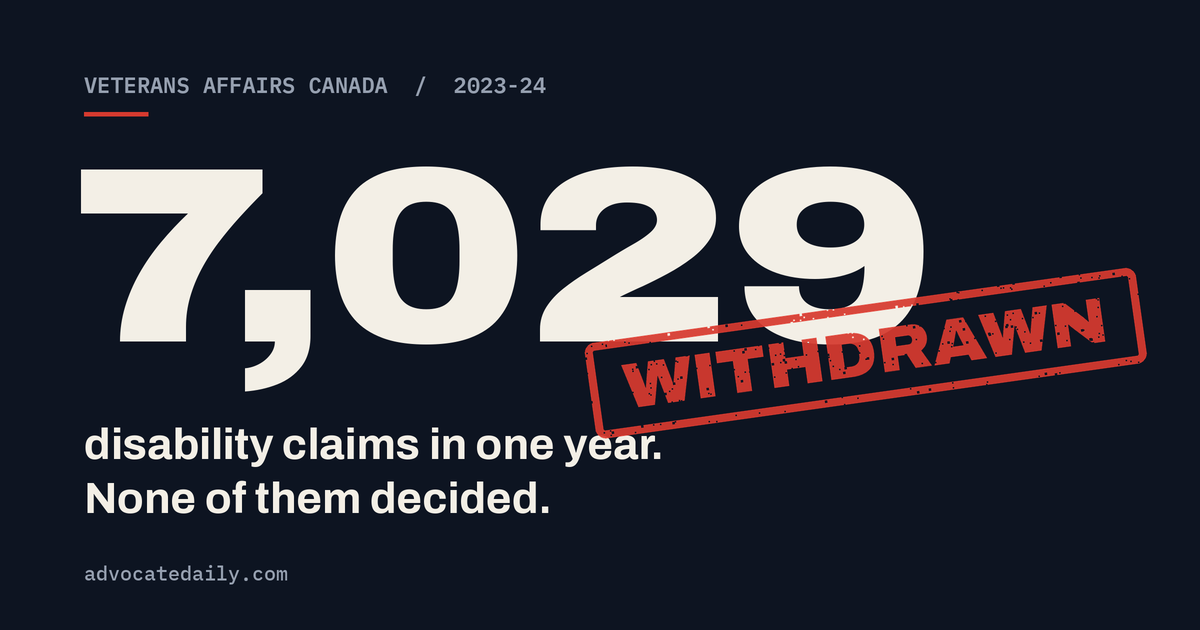
The same note has a table. Withdrawals for missing information or a missing diagnosis went from 1,259 in 2019-20 to 7,029 in 2023-24. The biggest category, failure to provide required medical information, climbed from 990 to 4,846 on its own.
Set that beside the refusals. In 2023-24 the department turned down 8,942 first applications after weighing them. Paperwork withdrawals are most of the way to that figure, and they show up in none of the numbers ministers recite.
The tables hint at more. In 2023-24 the department received about 80,300 applications and decided about 56,000, while the pending pile grew by roughly 3,200. That leaves around 21,000 applications that were neither decided nor still waiting at year end. The withdrawal codes account for 7,029. I couldn’t find a public explanation for the other 14,000.
Why this is a legal problem
Section 43 of the Veterans Well-being Act tells the minister, when making a decision, to resolve any doubt in the weighing of evidence in the applicant’s favour, and the appeal board is bound by a matching rule. The department’s own policy goes further and tells adjudicators to go looking for the basis of a claim.
Every one of those protections starts when somebody weighs evidence. A withdrawal letter tells the veteran the department can’t proceed to a decision, so the benefit of the doubt never comes into play. The review and appeal system, including the free lawyers at the Bureau of Pensions Advocates, is built around decisions. Whether a withdrawal letter is something a veteran can take to Federal Court is a question I’d like to see tested.
What I’d change
The department has done real work, and it deserves credit. Average turnaround on first applications fell from 48.8 weeks in 2020-21 to 20.2 weeks in 2023-24, before slipping back to 23.9 weeks in the first half of 2025-26. Service health records are now ordered automatically when an application lands, and a search tool pulls the relevant pages for the decision-maker. Decision letters get pre-filled from data already in the system.
Almost all of that helps the department’s side of the file. The one piece aimed at the documents a veteran has to chase is a portal that started with audiologists, who can send questionnaires in electronically. It’s the right idea applied to a single profession.
Here’s the number that should drive the design. As of September 30, 2024, 84 per cent of pending applications came from returning applicants claiming another condition. The department already has these people on file.
So pre-fill the veteran’s side of the form. Tell them what’s missing on the screen, before they submit, instead of by letter afterwards. At Caseway we automate court forms for law firms, and the lesson that carries over is a dull one: the cheapest place to catch a missing signature is before the form is filed.
Then count properly, which means starting the clock at submission and publishing withdrawals every quarter beside the backlog. The Auditor General found in 2022 that the department’s data was too poor to show whether its fixes were working. Budget 2025 set out $184.9 million over four years to stabilize processing and modernize the systems behind disability claims, with AI to support decision-makers. Some of that money belongs at the front door.
A refusal at least comes with a route to appeal. Seven thousand applications ended with a form letter in 2023-24, and until that number is published every quarter, nobody in Ottawa has to answer for it.
Al Vigier is the CEO of Caseway, an AI company that co-creates products with large enterprises and shares the revenue with them. He spent seven years in the Canadian Army, where he was shot.
