


Every legal software company says it is doing AI. Almost none of them will tell you the AI pilot cost or who funds the build. Caseway publishes its terms, including the price band. A Q&A with founder and CEO Al Vigier.
Al Vigier founded Caseway and publishes Advocate Daily. He answered these questions in writing.
Is the legal profession actually adopting AI, or is everyone just talking about it?
Both, and the gap between the two is the whole story.
Clio’s 2025 Legal Trends Report puts AI usage at 79 percent of legal professionals, up from 19 percent in 2023. That is one of the fastest adoption curves anyone has recorded for a professional tool.
Now look at the organizational number. Thomson Reuters surveyed more than 1,700 professionals across the US, UK and Canada and found 26 percent of legal organizations actively using generative AI, up from 14 percent. The ABA’s most recent Legal Technology Survey has firm adoption at 30 percent, with a spread from 47.8 percent at firms of 500 or more lawyers down to 17.7 percent for solos.
Those measure different things, so they are not contradictory. Individual lawyers are using AI. Their firms have not deployed anything. Thomson Reuters found that only 22 percent of professionals say their organization has a visible AI strategy, and 32 percent say their firm is moving too slowly. Clio found that 53 percent of legal professionals say their firm has no AI policy, or that they do not know whether one exists.
So you have widespread individual use, near total organizational paralysis, and a compliance exposure sitting in the middle of it.
Why the paralysis? These firms have budget.
Because the two obvious routes are both bad, and everyone can see it.
Route one is buying a generic AI tool and bolting it on. It demos beautifully and nobody uses it, because it does not know your forms, your rules or your jurisdiction. Note that even among firms using AI, only 40 percent are using legal-specific tools. The rest are pasting client matters into a consumer chatbot, which is its own problem.
Route two is building it yourself. That is eighteen months and a team you do not have, and at the end you have built infrastructure rather than a product.
Most organizations stall between the two and call it a roadmap. The numbers back that up. S&P Global’s 2025 survey of more than 1,000 enterprises found the share of companies abandoning most of their AI initiatives jumped to 42 percent, up from 17 percent the year before, with the average organization scrapping 46 percent of AI proofs of concept before they reached production. Gartner predicted that at least 30 percent of generative AI projects would be abandoned after proof of concept by the end of 2025, and separately that more than 40 percent of agentic AI projects will be cancelled by the end of 2027.
You have probably seen the MIT figure that 95 percent of enterprise AI pilots fail. I would treat that one carefully. It comes from a preliminary NANDA working paper built substantially on 52 interviews, and its actual finding was that 95 percent of organizations saw no measurable P&L impact, which is a different claim from “failed.” The S&P and Gartner numbers are larger samples and say enough on their own.
So Caseway’s answer is a partnership. What does that mean in practice?
We split the work along the line where each side is already strong.
The partner brings the workflow, the customers and the domain knowledge. We bring the form automation and the data infrastructure underneath it. Neither side pays the other to do something it is bad at.
Everything else in the model follows from that one decision.
Why forms? Of everything AI could do in law, form automation sounds like the least glamorous option available.
Because it is where the volume is, and because the failure is measurable.
In Canada, Justice Canada’s research found that between 40 and 57 percent of parties are self-represented when they appear in court on family law matters, and court-reported estimates run from 64 to 74 percent at the point of filing. The Canadian Forum on Civil Justice put the cost to Canadians of everyday civil and family legal problems at roughly $7.7 billion a year. South of the border, the Legal Services Corporation’s Justice Gap study found that low-income Americans get no or insufficient legal help for 92 percent of their substantial civil legal problems.
That is not a marketing problem. That is a throughput problem, and forms are where the throughput dies.
I will say plainly that there is no reliable national statistic for how many filings get rejected for form errors in either country. I looked. Nobody publishes it. Anyone quoting you a number on that is making it up.
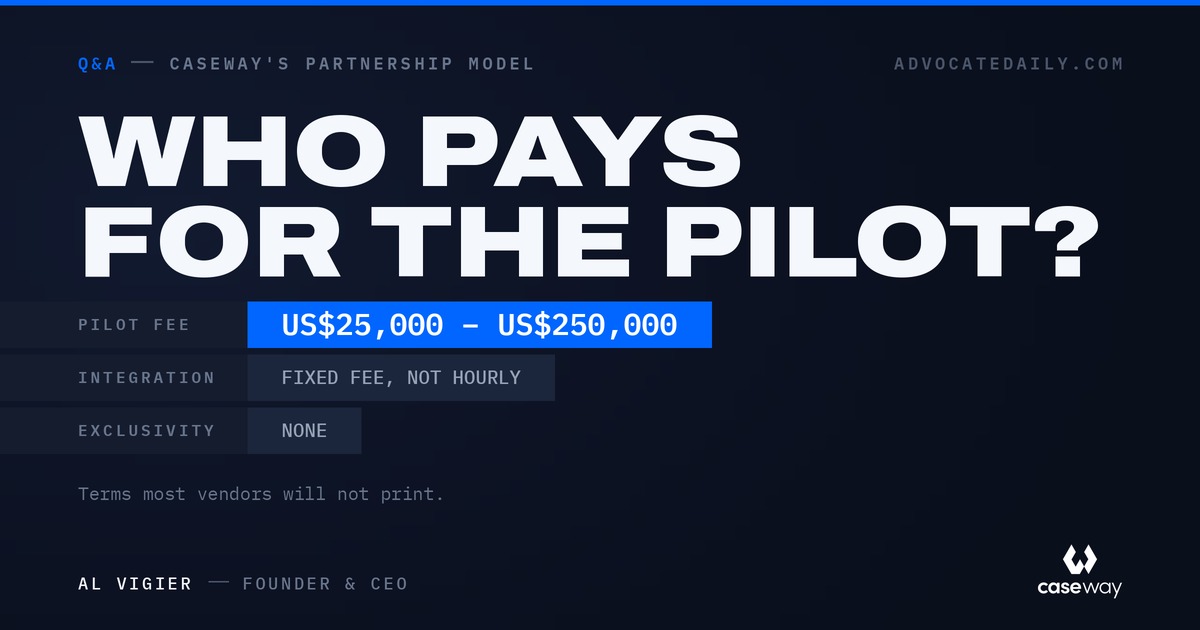
Who pays for the pilot?
The partner does, in most cases. That answer makes people uncomfortable, so I will explain it rather than soften it.
If we fund the pilot, we are a vendor working on spec, and spec work gets treated as free. Timelines slip. The partner’s engineers get pulled onto something else. Nobody on their side has money in it, so nobody defends it in a budget meeting six months later. That is how you end up in the 46 percent of proofs of concept that get scrapped.
If the partner funds it, the pilot has an owner. It gets staffed and it gets finished. And they end up owning a validated product they can sell, which is worth more than what they spent.
We frame it as market entry rather than a software purchase, because that is what it is. They are buying a position in a category.
What does an AI pilot cost?
Typically US$25,000 to US$250,000, depending on scope and how deep the integration goes. Some pilots carry no fee at all, usually where a grant or cost-share program covers it, or where the partner contributes infrastructure instead of cash.
Two honest caveats. First, that is our range, not an industry benchmark. No independent published benchmark exists for AI proof-of-concept pricing. I went looking and found nothing but vendor marketing dressed as research. Second, most companies will not print a range at all. I would rather talk to people who already know the number than spend three meetings walking someone toward it.
Integration is a fixed fee rather than hourly. Why?
Hourly billing pays the vendor to be slow. Fixed fee puts the overrun risk on us, which is where it belongs, because we are the ones who control how long it takes.
We do offer hourly co-development for clients who want us to build something outright with no partnership attached. Different product, different pricing.
Who owns what at the end?
Each side keeps its own IP. We keep ours, the partner keeps theirs, and anything built jointly gets settled in the agreement before work starts rather than after.
Non-exclusive, both directions. A partner asking for exclusivity in year one is asking us to bet the company on their sales team.
If the partner funds the build, where does Caseway’s revenue come from?
Downstream, on the licence, in one of two shapes.
Where we hold the customer contract, it is recurring licence revenue to us with a referral share back to the partner. Where the partner holds the customer contract, it is an OEM royalty or revenue share to us on every deal they close.
The partner makes money on hardware, infrastructure, seats and services, whatever their business already sells. The pilot fee pays for the build so the build actually happens. Our money comes later.
What happens between a first email and work starting?
Seven steps, run the same way every time.
- Initial meeting. Company background, the demo videos, and the commercial models.
- Mutual NDA sent.
- NDA signed.
- Technical meeting, with our CTO in the room.
- Proof of concept document sent, with the commercial terms inside it.
- PoC signed.
- Work starts.
Most vendors run four discovery calls before anyone says a number. We put the number in meeting one. It disqualifies people faster, which is the point.
Those sound like sales meetings.
They are not run that way. We sit in almost as part of the other side’s team and work out what actually needs help. Sometimes the honest answer is that the thing they asked about is not the problem, and the real problem is a form process three departments over. Better to find that in week one than in month nine.
What if the pilot fails?
Then it fails, and the partner has spent a defined amount to find that out. That is the cheapest available version of that discovery.
Compare it to the alternative. McKinsey, working with Oxford’s BT Centre for Major Programme Management, studied more than 5,400 IT projects and found that large IT projects run 45 percent over budget and 7 percent over time while delivering 56 percent less value than predicted. Software carries the highest overrun risk of any category. Every additional year on a project adds roughly 15 percent to the cost overrun. And around 17 percent of IT projects go so badly they threaten the existence of the company running them.
Those are the odds on an in-house build. A defined-cost pilot that fails in three months is a rounding error against that.
Why should a legal software company partner rather than build it internally?
Because the market is consolidating faster than anyone can ship.
Clio closed a US$1 billion acquisition of vLex alongside a US$500 million Series G at a US$5 billion valuation, the largest transaction legal technology has seen. Dye & Durham, meanwhile, went from strategic review to a formal sale process inside six months. Third-party estimates of the market vary by an order of magnitude depending on how you draw the boundary, from roughly US$1.45 billion for legal AI specifically to US$34 billion for legal technology broadly, which tells you the category is being defined right now rather than divided up.
If you are a legacy platform with a large installed base and a slow release cycle, an eighteen-month internal AI build finishes after the window closes. Even the contested MIT paper found something worth noting on this point: its lead author told Fortune that buying from specialized vendors and building partnerships succeeded around 67 percent of the time, while internal builds succeeded roughly one third as often.
Who have you actually done this with?
The public one in legal is 8am, formerly AffiniPay, the parent of MyCase, LawPay, CASEpeer, Docketwise and CPACharge, serving more than 245,000 legal and accounting professionals. Bob Ambrogi covered the original CaseForm court form automation partnership at LawSites, and Law.com carried the MyCase integration in its Legalweek 2026 rundown. It runs on revenue share, co-marketing and a marketplace listing.
We hold a master partnership with Sidian Technologies covering the California legal market. Douglas Magazine wrote that one up.
Outside legal, the same model runs on hardware. MiTAC Advanced Technology in Taiwan and Valtec in Canada are both public. The Logic covered Caseway last month in a piece on the Canadian companies going after Palantir’s position.
Others are under NDA and will stay that way.
You are a Canadian company selling into a market dominated by American software. Does that help or hurt?
Right now it helps, and the underlying numbers explain why.
Statistics Canada’s most recent business survey has 19.2 percent of Canadian businesses using AI to produce goods or deliver services, tripled from 6.1 percent two years earlier, with 40 percent still saying AI is not relevant to them. That is a large, mostly untouched domestic market. Ottawa has also started naming itself the anchor customer for Canadian AI, which I have written about in The Line and here on Advocate Daily.
Buyers in regulated sectors are also asking questions they did not ask three years ago about where the model runs and who can switch it off. I made that argument in BetaKit and in RealClearDefense. Law firms hold privileged material. Those questions land the same way in a law firm as they do in a defence ministry.
Who is a bad fit for this?
Three types, and naming them saves everyone time.
Anyone who wants a free pilot. If nobody on your side is paying for it, nobody on your side will finish it. See the 46 percent.
Anyone who wants exclusivity before a single line of code exists.
Anyone who wants to hand over a requirements document and receive software back. If your team is not in the build, what we hand you will not fit your business, and that will not be a documentation problem.
Why publish any of this? Most companies keep commercial terms behind a sales process.
Because the terms are not the hard part. Execution is.
If a competitor reads this and copies the structure, they still have to build the software and do the work, and I have lost nothing. What I gain is that the people who email me have already decided they are comfortable with the model. That is worth more than a longer pipeline of people who were never going to sign.
Caseway is fifteen people in Vancouver. We do not have the budget to spend six months educating a prospect toward a number they were always going to reject.
Al Vigier is the founder and CEO of Caseway, a Vancouver-based AI company building form automation and data intelligence for enterprises and government. He is also the owner of Jusu, a plant-based wellness brand. He served seven years in the Canadian Army and sat on the board of The Last Post Fund for ten years.
