


By Alistair Vigier
Vexatious litigation in Canada and the United States is jamming up the courts. The systems used to identify these litigants are slow, reactive, and built for a paper era. The cost is a justice system that runs slower for everyone else.
In 2018, after six years of fighting a credit union over her late mother’s estate, after passing through the hands of 23 different judges, and after running up more than $243,000 in court-ordered costs against herself, Janet Hoessmann was finally banned from suing without permission. Justice Kenneth Ball of the BC Supreme Court called her conduct “reprehensible and remarkably wasteful.” That was the formal language. The plain version is that one self-represented litigant in one province burned through more judicial time than most full-blown commercial trials.
She is not unusual. She is just visible.
Vexatious Litigation in Canada: Nine Regimes, No Registry
In April of this year, Justice Nicholas Devlin of the Alberta Court of King’s Bench declared another woman vexatious after a five-year fight over a house sale. His closing paragraph reads less like a judgment than a piece of clinical prose: “The court sincerely hopes she is able to find relief from the obviously compulsive distress the sale continues to cause her, going on five years later. That relief will, however, not come from the court and must not come at any further expense in time, stress or resources to innocent parties.”
In Toronto, an Ontario lawyer named Shane O’Herlihy was declared vexatious last year for a campaign that included 392 emails and voicemails over 318 days, 2,374 cross-examination questions, and labelling a city employee a “Pride Killer.” A lawyer. Declared vexatious by his own court.
These are not edge cases. They are the surface of a much larger problem that the legal profession has been politely refusing to discuss for about forty years.
What the word actually means
The Canadian Bar Association’s National magazine recently ran a piece titled “The vexing problem of vexatious litigation.” The article quotes Donald Netolitzky, the former complex litigant management counsel at the Alberta Court of King’s Bench and the closest thing Canada has to a national authority on the topic. His framing is worth repeating because most lawyers I talk to get it wrong.
“Vexatious has a very simple commonplace meaning,” Netolitzky said. “It means that you’re a problem, you’re out to hurt somebody, you’re out to vex them.”
That is distinct from frivolous, which means a claim with no legal basis, and abusive, which means using the court process for an improper purpose. A litigant can be one, two, or all three at once. Most repeat offenders eventually become all three.
Netolitzky’s other observation is the one that should be driving policy: “This is really a mental health phenomenon, in my opinion, more than anything else. Courts are not intended to handle people’s mental health issues.”
His 2017 study of self-represented appellants at the Supreme Court of Canada found that approximately 70 percent had an abusive litigation record by the time they reached that level, and roughly 40 percent had identifiable mental health problems. Those are not numbers from a tabloid. That is the actual filtered population at the top of the country’s appellate pyramid.
The law on the books
Canada has nine different vexatious litigant regimes for nine different jurisdictions, plus a federal one. Section 40 of the Federal Courts Act lets the Federal Court bar persistent vexatious filers, but only with the consent of the Attorney General of Canada. Ontario uses section 140 of the Courts of Justice Act, which was significantly expanded in August 2024 under Bill 157 to let judges issue orders on their own initiative and to give the Court of Appeal jurisdiction it never previously had. British Columbia uses section 18 of the Supreme Court Act.
Alberta uses sections 23 and 23.1 of the Judicature Act, supplemented by the Hok two-step procedure that the Court of King’s Bench developed in 2016.
Quebec is the outlier. It runs an actual public registry under article 84 of the Code of Civil Procedure. As of 2022, the Montreal district list named 336 individuals. That is the only formal vexatious litigant registry in Canada. Everywhere else, you have to assemble the list yourself by searching CanLII case by case.
The American system is fragmented in a different way. There is no federal vexatious litigant statute. Federal courts rely on the All Writs Act, 28 U.S.C. section 1651, plus inherent supervisory power, plus Rule 11 sanctions. The leading test comes from the Ninth Circuit’s 1990 ruling in De Long v. Hennessey, which requires four things before a prefiling order can issue: notice, an adequate record, substantive findings of frivolousness, and an order narrowly tailored to the specific conduct. The Second Circuit added a five-factor version in Safir v. United States Lines.
How Vexatious Litigation in Canada Actually Works
State law is where it gets interesting. California’s Code of Civil Procedure section 391, first enacted in 1963 and most recently amended in 2022, is the gold standard. The Judicial Council of California maintains a public list that is updated monthly. The current PDF, dated April 1, 2026, runs to several thousand entries. Texas runs a similar list under Chapter 11 of its Civil Practice and Remedies Code.
Florida’s regime, originally enacted in 2000, was substantially expanded in July 2025 to extend the lookback period from five to seven years and to include family law, small claims, and out-of-state cases. Ohio, Hawaii, Nevada, and a handful of others have parallel statutes.
Quebec has 336 registered names and California has thousands. The two jurisdictions are roughly comparable in population. Either Quebeckers are dramatically better behaved, or one of these systems is actually finding the problem and the other is not.

The numbers nobody publishes
Canada does not produce a national statistic on vexatious litigation. Nobody does. What exists are proxies, and the proxies are unflattering.
Trevor Farrow’s Canadian Forum on Civil Justice cost-of-justice study, published out of Osgoode Hall Law School, found that Canadians spend $7.7 billion annually on everyday legal problems. The state spends another $799 million on the social costs that flow from unresolved disputes. The average Canadian spends $6,100 per legal problem, and 51 percent of people experiencing a problem report increased stress as a result. None of that money distinguishes between productive litigation and vexatious litigation, which is part of the problem.
Self-represented litigant rates tell a similar story. Julie Macfarlane’s 2013 National Self-Represented Litigants Project study found that 64 percent of family court cases in Ontario, and 74 percent of cases in Toronto’s two main family courts, were begun by people without lawyers. Macfarlane updated that figure in 2021: “In the 1980s, about one percent of people represented themselves in court.
The National Self-Represented Litigants Project
Today, in family courts, it’s over half.” The vast majority of self-represented litigants are not vexatious, but most vexatious litigants are self-represented. The two populations overlap heavily, which is why the National Self-Represented Litigants Project has been warning since 2019 about what it calls “vexatious lite,” meaning judges using the language of vexatiousness without ever issuing the formal order.
The American numbers are easier to find. The Administrative Office of the U.S. Courts reported that pro se filings made up 50 percent of new appellate cases in 2025, totalling 20,878 cases, up nine percent year over year. Civil cases pending more than three years rose 346 percent over two decades, from 18,280 in March 2004 to 81,617 in March 2024.
In Canada, criminal-court delays under R v. Jordan have produced an even starker number. According to Globe and Mail and Statistics Canada reporting, 9,560 cases were stayed or withdrawn for unreasonable delay in 2023 to 2024. The peak was 11,132 cases in 2022 to 2023. About 10,000 criminal prosecutions a year are getting tossed because the system cannot move them through fast enough. Chief Justice Richard Wagner of the Supreme Court of Canada was unusually direct about it at his June 2024 press conference: “One stay of proceedings is one too many, let’s be clear on that.”
Vexatious litigation is not the only reason for the backlog, but it is a meaningful slice of it that almost nobody quantifies.
Why we do not flag earlier
Netolitzky’s other criticism in the National Magazine piece is the one I keep coming back to. Canada’s vexatious litigant regime, he said, is “a backwards, punitive sort of process.” It only works after the damage is done. By the time a court declares someone vexatious, that person has typically already filed dozens of actions, generated hundreds of thousands of dollars in costs, and consumed hundreds of hours of judicial time.
The hallmarks are well known. Justice David Stratas of the Federal Court of Appeal laid them out in Olumide v. Canada in 2017. Repetitive relitigation. Frivolous appeals. Refusal to pay costs. Allegations of corruption against opposing counsel and judges. Personal attacks. Volume for the sake of volume. None of these are subtle. A clerk who has been on the job for six months can recognize them.
The State of Vexatious Litigation in Canada
The problem is that nobody is connecting the dots across jurisdictions. In National Bank of Canada v. Taha in 2022, the Federal Court declared a litigant vexatious only after the Prince Edward Island Supreme Court had already done so. The opposing parties had to re-prove the entire history because there is no automatic interprovincial recognition. The same person who is barred from filing in PEI can walk into a courthouse in Calgary the next day, and unless the prothonotary happens to recognize the name, nothing stops them.
California’s section 391 statute does at least allow out-of-state declarations to count as a basis for new findings. Texas does the same. But each state still maintains its own registry, and there is no national American registry either.
This is a data problem dressed up as a legal problem.
What pseudolaw looks like
A category of vexatious filing worth flagging on its own is what Associate Chief Justice John Rooke of the Alberta Court of King’s Bench labelled “Organized Pseudolegal Commercial Argument” or OPCA litigation, in his 188-paragraph 2012 ruling Meads v. Meads. That decision is now the most-cited Canadian judgment internationally on the subject of pseudolaw.
Rooke’s prose is bracing. “When reduced to their conceptual core, most OPCA concepts are contemptibly stupid.” And: “OPCA litigants appear, engage in a court drama that is more akin to a magic spell ritual than an actual legal proceeding, and wait to see if the court is entranced and compliant.”
Mr. Meads had served Justice Rooke a “fee schedule” demanding two million dollars in gold or silver every time the judge dismissed one of his arguments. Rooke noted dryly that the gurus who sell these strategies could not name a single instance in which the spells had ever worked. “Your spells, when cast, fail.”
OPCA is the most dramatic version of the phenomenon, but the underlying behaviour is the same as garden-variety vexatious litigation. Persistent filings. Belief that the court is corrupt. Claims that grow more grandiose with each loss. Complete refusal to engage with the law as it actually exists.
The American sideshow
The United States has the most prolific vexatious litigant in legal history, and his story is worth telling because it tells you something about how broken the prefiling-order system is when applied piecemeal.
Jonathan Lee Riches filed his first lawsuit on January 8, 2006, while incarcerated at the federal medical centre in Lexington, Kentucky. By January 2008, PACER showed 474 actions. By June 2008, the Western District of Wisconsin reported he had filed 1,834 lawsuits, 1,540 of them in the first six months of 2008 alone. Prison Legal News estimated his total at over 3,000 federal cases by 2013. Riches himself, in a lawsuit against Guinness World Records for naming him the most litigious person in history, claimed somewhere between four and five thousand.
His named defendants included Britney Spears, Steve Jobs, Bill Belichick, Janet Reno, Plato, Nostradamus, the Lincoln Memorial, the Eiffel Tower, the Holy Grail, Pluto, Three Mile Island, Plymouth Rock, the Roman Empire, Adolf Hitler’s National Socialist Party, the Olsen Twins, Kim Kardashian, and at one point 790 additional defendants spread across 57 pages.
In March 2008, Judge Willis B. Hunt Jr. of the Northern District of Georgia dismissed 276 of Riches’s cases in a single order. The federal courts eventually issued a permanent injunction. But the injunction came years and thousands of filings into the campaign, and only because each district had to independently arrive at the conclusion that he was a problem.
Compare that to the early-warning value if a single national database had flagged the second filing instead of the two thousandth.
Where the technology actually sits
A reasonable person reading the above would assume that some American or Canadian or British court has built an algorithm to flag this stuff. They have not.
I could not find a single court in any common-law jurisdiction that has publicly deployed an AI system to identify vexatious or repeat filers at intake. The closest active practice is procedural. Alberta’s Civil Practice Note 7, in force since 2018, gives judges an “Apparent Vexatious Application or Proceeding” summary procedure. Ontario’s August 2024 Regulation 322/24 lets a registrar refuse to file documents from someone already declared vexatious. Both are improvements. Neither is automation.
Pretrial criminal-risk assessment tools like COMPAS and the Public Safety Assessment exist, and they have been the subject of a decade of fierce litigation and academic critique, including ProPublica’s 2016 investigation and the Wisconsin Supreme Court’s State v. Loomis ruling. Whatever you think of those tools, they are not solving the vexatious litigation problem because they were not built to.
The Conflict Analytics Lab
Samuel Dahan at Queen’s Law runs the Conflict Analytics Lab, which has built OpenJustice and MyOpenCourt. OpenJustice now handles roughly 20,000 queries a month. The Law Foundation of Ontario gave the lab $467,000 to build an AI tool for Pro Bono Ontario’s housing work. Dahan’s framing is correct: “Ninety percent of cases are settled outside the courts and litigants are self-represented. We’re building an AI tribunal for small claims disputes.” That is the demand side of access to justice. None of it touches the courts’ ability to identify problem filers.
The reason is not technical. The reason is that Canadian and American courts do not have the data infrastructure to flag patterns in the first place. CanLII publishes only what judges send it, and only the published decisions, not the docket. Most provincial superior court dockets are not online or are online behind paywalls or searchable only one case at a time. The federal court and BC do reasonably well. Ontario’s new Public Portal launched in October 2025 in Toronto only and will not be province-wide until approximately 2030.
You cannot run pattern recognition on a system that does not publish patterns.
The conflict of interest in plain view
I have a stake in this. Caseway, the company I run, was sued by CanLII in November 2024 for accessing court data the public pays for. We settled in 2026. CanLII is a not-for-profit owned by the Federation of Law Societies of Canada, and it is currently the only place a Canadian can search judicial decisions for free. Its mandate is open access. Its policy on bulk data has been less open. Reasonable people can disagree about whether that is the right balance.
What is harder to disagree about is the consequence. If the people closest to the problem cannot get access to the data, the people running the courts will not be the first to spot the patterns. They will be the last. They have been the last for forty years.
Ade Olumide was declared vexatious in three separate forums (the Federal Court, the Federal Court of Appeal, and the Ontario Superior Court of Justice) and the Supreme Court of Canada denied him leave to appeal four times before the situation stabilized. Each declaration was issued independently. Each cost time and money to obtain. None of them communicated automatically with the others.
If a private credit reporting agency were running this system, it would be embarrassing. The justice system runs it because there is nothing else.
What good would look like
I think there are five things that should happen, and only one of them requires AI.
First, every Canadian province should publish its vexatious litigant orders the way Quebec does. Section 84 of the Quebec Code of Civil Procedure has been on the books since 2009. It is not radical. It is not technologically demanding. The other provinces have not done it because they have not been asked to.
Second, court dockets should be searchable. Not the decisions, the dockets. PACER is not a perfect system, but the United States can tell you in seconds how many federal cases a person has filed. Canada cannot, and it is not because we lack the technology.
Canada should also adopt the equivalent of California’s section 391(b)(4) recognition rule, so that an Ontario vexatious litigant order is automatically treated as a relevant factor in BC. The provinces already recognize each other’s commercial judgments. Vexatious orders should be no harder.
Fourth, the courts should use the data they already have to flag patterns at intake. A clerk in Edmonton should not need to remember a name. The system should remember it.
Vexatious litigation in Canada
Fifth, and only fifth, AI can help. Not as a judge or as a gatekeeper, but as software that helps overworked clerks notice when they are seeing the seventh filing this year from someone they should be paying attention to. The same technology that lets a self-represented tenant find a useful precedent for her residential tenancy hearing can also help a court spot the person who filed 392 emails about the same dispute.
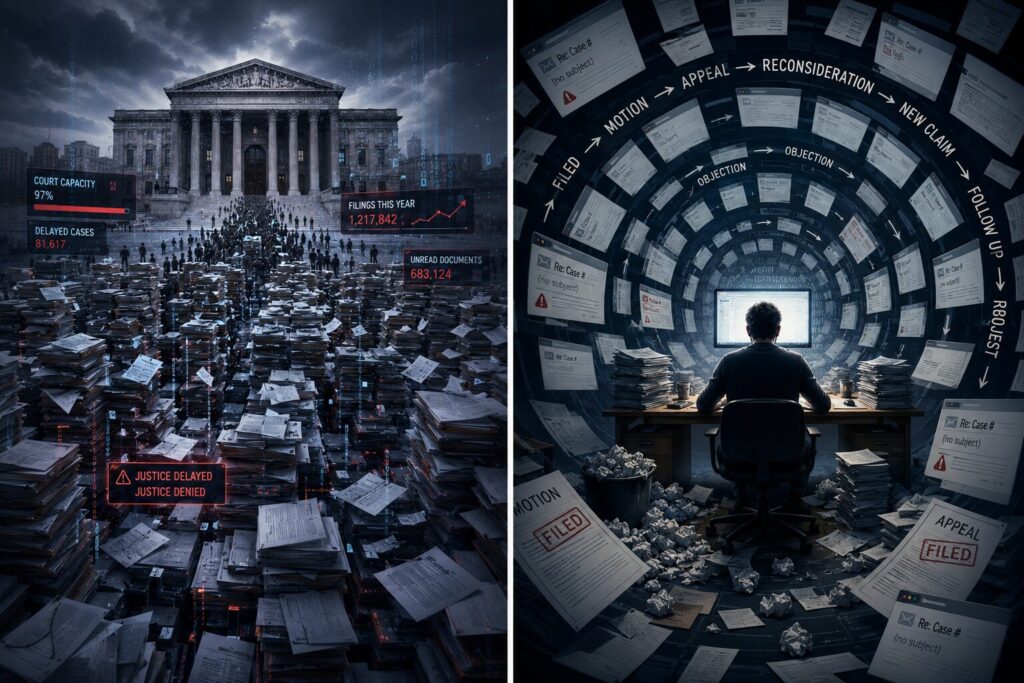
Justice Stratas put the underlying principle as well as anyone in Olumide. The courts, he wrote, are “community property” and “scarce natural resources.” They exist “to further access to justice by those seeking the resources of the court in a proper way.”
That principle cuts in both directions. We are not going to solve the access-to-justice problem by being afraid to identify the small minority of users who are consuming a disproportionate share of the resource. And we are not going to solve it by treating every self-represented litigant as if they were that minority either.
The most useful test, in my experience, is the one Justice Devlin reached for in his April ruling. Compulsive distress is not a legal category. But it is recognizable, and a system that can recognize it earlier will be a system that protects both the vexatious litigant from herself and the rest of us from her.
We are not there yet. We could be.
_______________
Alistair Vigier is the CEO of Caseway, a Vancouver-based legal AI company. He previously worked in divorce law, and served seven years in the Canadian Army.
